

Designing cooling channels in industrial molds is a crucial aspect that can significantly impact the quality, efficiency, and cost - effectiveness of the manufacturing process. As an industrial molds supplier, I've had my fair share of experiences and learnings in this area. In this blog, I'll share some tips on how to design these cooling channels like a pro.
Understanding the Basics
First things first, you need to understand why cooling channels are so important. When you're molding plastic or other materials, the molten material is injected into the mold cavity. As it cools, it solidifies into the desired shape. If the cooling process isn't managed properly, you can end up with all sorts of problems. For example, uneven cooling can cause warping, shrinkage, and internal stresses in the molded part. These defects can affect the part's functionality and aesthetics, leading to higher rejection rates and increased costs.
Analyzing the Part and Mold
Before you start designing the cooling channels, you need to take a good look at the part you're going to mold and the mold itself. Consider the size, shape, and complexity of the part. For instance, if you're dealing with a large, thick - walled part, it will take longer to cool compared to a small, thin - walled one. You also need to think about the material you're using. Different materials have different thermal properties, which will affect the cooling rate.
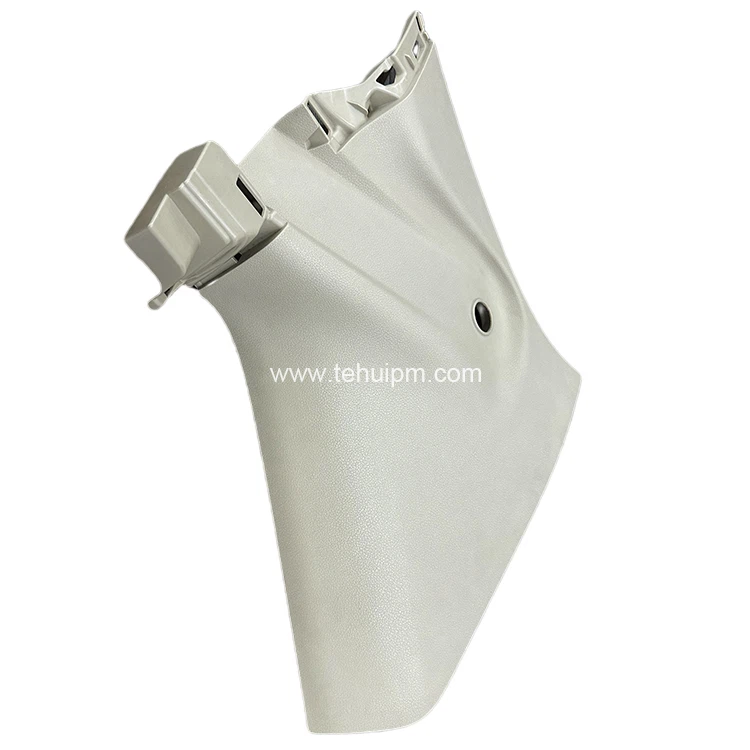
Let's say you're working on [Rearview Mirror Injection Molding](/automotive - plastic - parts/rearview - mirror - injection - molding.html). Rearview mirrors are usually made of plastic and have a relatively complex shape. You'll need to ensure that the cooling channels are designed in a way that can effectively cool all the intricate details of the mirror. Otherwise, you might end up with a distorted or poorly finished product.
Choosing the Right Cooling Channel Layout
There are several types of cooling channel layouts, and the one you choose depends on the part and mold characteristics.

Straight Cooling Channels
Straight cooling channels are the simplest and most common type. They're easy to machine and are suitable for parts with simple geometries. You can drill straight holes through the mold plate, and the coolant flows through these holes to remove heat from the mold. However, straight channels may not provide uniform cooling for complex parts.
Baffled Cooling Channels
Baffled cooling channels are a modification of straight channels. A baffle is placed inside the channel to direct the coolant flow. This helps to improve the cooling efficiency by ensuring that the coolant reaches all areas of the mold. Baffled channels are a good choice for parts with moderate complexity.
Cooling Inserts
For parts with very complex geometries or areas that require precise cooling, cooling inserts can be used. These inserts are made of materials with high thermal conductivity, such as copper alloys. They can be placed close to the critical areas of the mold to provide targeted cooling.
Let's take [Plastic Car Parts](/automotive - plastic - parts/plastic - car - parts.html) as an example. Car parts can have various shapes and sizes, from small interior components to large body panels. For a small, detailed interior part like an air vent, you might use cooling inserts to ensure that all the fine features are cooled properly. On the other hand, for a large body panel, a combination of straight and baffled channels could be more appropriate.
Calculating the Cooling Requirements
Once you've chosen the cooling channel layout, you need to calculate the cooling requirements. This involves determining the amount of heat that needs to be removed from the mold and the flow rate of the coolant.
The amount of heat to be removed depends on the mass of the material being molded, its specific heat capacity, and the temperature difference between the molten material and the desired final temperature. You can use some basic thermodynamics equations to calculate this.
The flow rate of the coolant is also crucial. If the flow rate is too low, the coolant won't be able to remove the heat effectively. On the other hand, if the flow rate is too high, it can cause excessive pressure drop and increase the energy consumption. You need to find the right balance.
Optimizing the Cooling Channel Design
After you've done the initial design and calculations, it's time to optimize the cooling channel design. You can use computer - aided engineering (CAE) software to simulate the cooling process. This software can help you visualize the temperature distribution in the mold and identify any areas where the cooling is inadequate.
For example, if you're designing an [Air Conditioning Panel Plastic Mould](/automotive - plastic - parts/air - conditioning - panel - plastic - mould.html), CAE simulation can show you if there are any hot spots in the mold that could lead to defects in the panel. Based on the simulation results, you can make adjustments to the cooling channel layout, size, or coolant flow rate.
Manufacturing and Maintenance
Once the cooling channel design is finalized, it's time to manufacture the mold. The cooling channels need to be machined with high precision to ensure proper coolant flow. Any rough surfaces or blockages in the channels can reduce the cooling efficiency.
After the mold is in use, regular maintenance is essential. The coolant can carry debris and contaminants, which can accumulate in the cooling channels over time. This can block the channels and reduce the cooling performance. You should clean the cooling channels periodically and check for any signs of leakage or corrosion.
Conclusion
Designing cooling channels in industrial molds is a multi - step process that requires a good understanding of thermodynamics, part design, and manufacturing processes. By following the steps outlined above, you can design cooling channels that provide efficient and uniform cooling, resulting in high - quality molded parts.
If you're in the market for industrial molds and need expert advice on cooling channel design, feel free to reach out. We're here to help you get the best possible results for your manufacturing needs.
References
- "Mold Design Handbook" by Peter F. Otten
- "Plastics Processing: Modeling and Simulation" by Steven H. Duvall
- Various industry research papers on mold cooling technology.